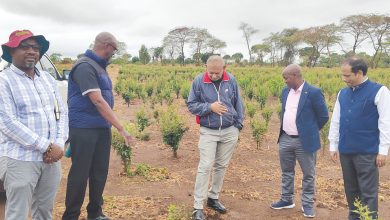
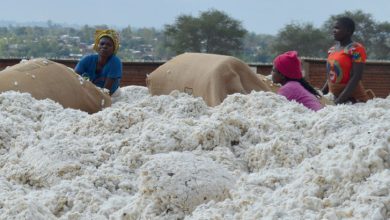
When rain failed last year, women in Banana Village, Traditional Authority Jalavikuwa in Mzimba District, refused to surrender.
Armed with hoes, watering cans and buckets, they took to winter cropping in the nearest wetland as their last resort.
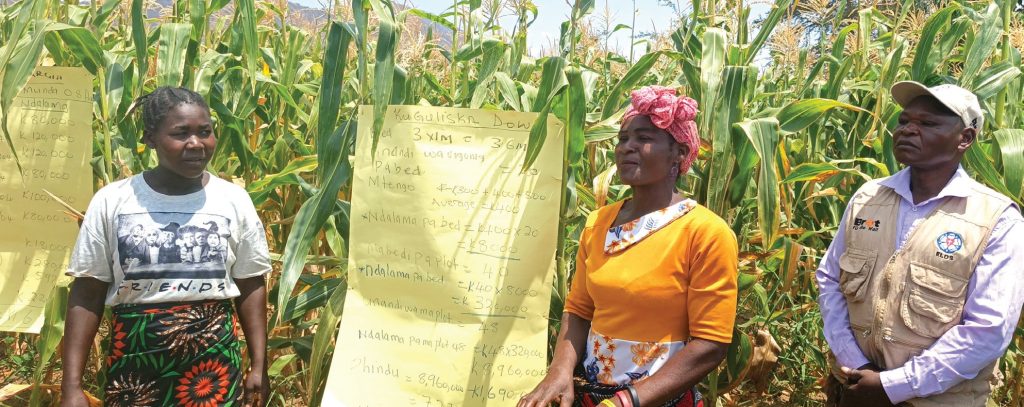
“We laboured for the crop that would save us months later,” recalls Muni Nyirenda, 29. “We dug cracked earth until our hands cracked. We had no pump, only hope.”
The secretary of Chamfuko Micro Irrigation Scheme says the vast lowlands along Kasito River, a tributary of South Rukuru, has been idle for “lost decades”.
The fertile but neglected stretch was ripped and stripped of its msangu trees by brick-making.
Farmers upland waited for the rains, but the skies keep failing them.
Across the country, 80 percent of farmers rely on unpredictable rainfall, but droughts, storms and floods dump millions in hunger and poverty amid climate change.
The Malawi Vulnerability Assessment Committee reports that nearly 4.4 million Malawians require food aid until the next harvesting season in March.
President Peter Mutharika has declared a state of disaster in all 28 districts, following a spate of drought and pest attacks.
The World Food Programme attributes the worsening food crisis to a chain of climate shocks.
Last year, the Evangelical Lutheran Development Service (ELDS) rolled out a three-year initiative in Mzimba North in response to hunger and poverty fuelled by chronic crop losses, limited access to irrigation and rising vulnerability of women and the elderly.
The Bread for the World of Germany funds the Climate Resilience and Sustainable Livelihoods Project, which supports about 1 500 households surrounding the irrigation scheme.
It trained them in climate-smart farming and how to run small-scale enterprises.
The project aims to reach 7 500 people in 17 villages, according to ELDS project officer Gazeli Phiri.
Chamfuko is one of four irrigation schemes supported by the project.
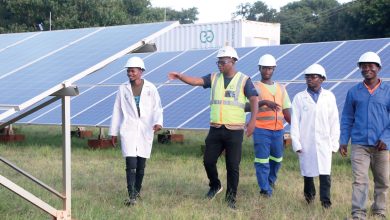
“Having seen their struggle, we came to their rescue with two solar panels that lifts water straight from the stream to the gardens,” Phiri says.
Phiri adds that under the project, they train farmer groups to “ensure water, seed and markets move together”.
“Our goal is to promote climate-smart agriculture, improve incomes, strengthen nutrition and reduce disaster risk in the long term,” he said.
Bwengu agricultural extension development officer Jaten Kalagho says Chamfuko farmers who once planted on scattered patches now irrigate a 4.3 hectare block.
“They use basin irrigation to guide water from a main canal into feeder channels, intercropping maize, beans and soybeans,” he says.
The group, comprising 20 women and two men, spent K1.2 million on farm inputs and harvested crops worth K8.96 million.
“We made a profit of K7.96 million after planting in June,” Nyirenda says.
Eliza Zgambo sold her green maize at K450 000 to lift her family out of poverty.
Traditional Authority (T/A) Jalavikuwa says farming beyond the erratic rainy season guarantees farmers improved incomes and food security.
“Irrigation has made a huge difference where floods, droughts and hunger recurred,” he says.
Mzimba North district irrigation officer Aaron Msiska says crop yields and livelihoods are improving “as farmers can control water and plan their harvests”.
“It is the best way to protect livelihoods amid climate change,” he says.
This year, agricultural authorities in Rumphi have irrigated 75 percent of the targeted 3 350 hectares.
“When partners like ELDS come in, government efforts move faster. Together, we can achieve high productivity and agricultural commercialisation in line with the Malawi 2063 vision,” he says.
Jalavikuba discourages the production of charcoal and bricks to conserve trees, fertile trees and water.
“People cut trees for bricks, yet there is no farming without trees. If the rivers dry, the pumps stop. We must plant trees along the riverbanks for our fields to survive. It takes everyone, from the village to the nation, to protect our trees.”